Quick answer: Use Zapier when you want the fastest simple automation between popular apps. Use n8n when you need a real AI agent workflow: tools, structured output, branching, retries, self-hosting, and deeper control. For Ship Lean-style systems, Zapier is a shortcut. n8n is the runner layer.
If you are new to the concept, start with what an n8n AI agent is. If you already know you want n8n, use the n8n AI Agent Workflow Builder.
Quick ComparisonQuestion
n8n AI Agent
Zapier AI ActionsBest for
Custom AI workflows with tools
Fast app-to-app AI actionsBuilder type
Technical solo builder, operator, team
Nontechnical operator, speed-first builderAgent depth
Stronger for tool-using workflows
Better for simple AI-assisted actionsHosting
Cloud or self-hosted
CloudWorkflow control
High
MediumDebugging
Node-level runs and logs
Simpler task historyBest first use
Agentic routing, enrichment, approval
Simple summaries, drafts, app updatesThis is not a moral decision. It is an architecture decision.
What n8n Does Better
n8n is stronger when the workflow has real logic:the agent needs to choose between tools
the output needs a structured schema
you need custom code in the middle
you want to self-host
the workflow needs approvals before publishing
the run history matters because this is becoming an operating systemThat makes n8n a better fit for durable AI workflows.
For example, a Search Console workflow might:Pull query/page data.
Ask an AI Agent node to classify the opportunity.
Use a tool to inspect the current page.
Return structured fields: refresh, build, or ignore.
Create a draft task.
Ask for human approval before publishing.That is more than "summarize this row." It is a small operating loop.
What Zapier Does Better
Zapier is stronger when speed and app coverage matter more than control.
Good Zapier use cases:summarize a form submission
draft a Slack reply
move a lead into a CRM
create a simple email draft
connect two common SaaS tools quicklyIf the workflow is simple, Zapier may be the better first move. The fastest useful automation often wins.
The Hidden Question: Do You Need an Agent?
Most workflows do not need an agent.
Use simple automation when the rule is clear:Task
UseNew form submission goes to CRM
Simple automationNew meeting gets a Slack reminder
Simple automationSupport message needs urgency classification
AI stepSearch query needs refresh/build/ignore judgment
AI agentPublic content needs approval
AI agent plus human reviewIf the workflow is just moving data, do not make it agentic. If the workflow needs judgment, tools, and routing, n8n gets more interesting.
The Ship Lean Pick
For a solo builder trying to grow organic traffic, I would use:Codex or Claude Code to build and refresh pages
n8n to pull recurring signals, route tasks, and manage approvals
Zapier only when a simple SaaS handoff is faster than building a custom n8n workflowThat keeps the core system owned by you while still allowing shortcuts when they are actually shortcuts.
When I Would Choose Each
Choose Zapier if:you need a working automation today
the workflow has two or three simple steps
you do not care about self-hosting
you do not need custom agent toolsChoose n8n if:you are building an AI agent workflow
you need structured output and branching
you want lower-level control
you want self-hosting or deeper data ownership
you want the workflow to become part of your operating systemFor deeper n8n patterns, read the n8n AI Agent Tutorial and n8n AI agent vs workflow automation.
Quick answer: An AI coding agent builds and changes the system. Workflow automation runs the system. If you mix those jobs up, you either get a fragile script pretending to be operations or a giant canvas pretending to be a developer.
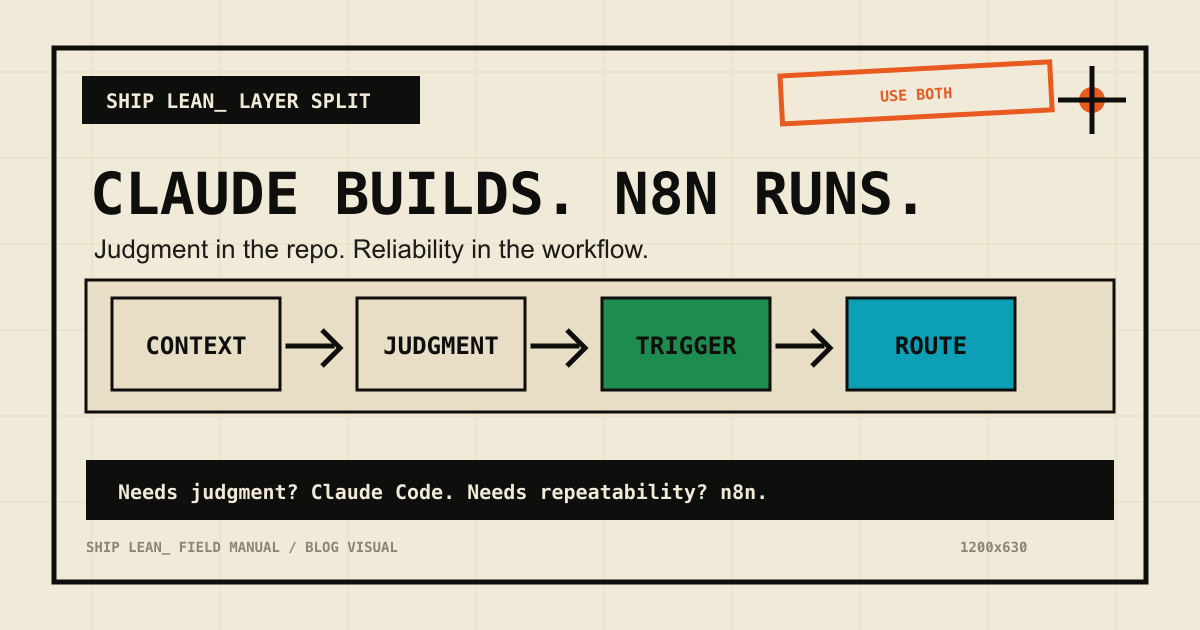
For Ship Lean, the clean split is:Claude Code or Codex builds. n8n runs. Human approves.That rule is the center of the n8n AI Agents hub.
The Actual DifferenceLayer
AI coding agent
Workflow automationPrimary job
Build, edit, reason, test
Trigger, route, retry, logBest context
Repo files, docs, diffs, terminal output
App data, schedules, webhooks, credentialsOutput
Code, content, config, PR-ready changes
Runs, records, notifications, approvalsFailure mode
Bad edit or bad assumption
Broken credential, bad input, failed nodeBest tools
Codex, Claude Code, Cursor
n8n, Make, ZapierAn AI coding agent is closer to a builder.
Workflow automation is closer to an operations layer.
Why This Matters for Organic Traffic
Modern SEO is not "write 50 posts and hope."
The better system is:Pull real demand signals from Search Console.
Identify pages Google is already testing.
Refresh the page with clearer answers, schema, internal links, and proof.
Build a tool, workflow, or comparison page when the query deserves it.
Route the work through human approval.
Measure again.That system needs both layers.
n8n can pull the data and create the weekly queue. Codex can read the page, update the repo, run the build, and verify the result. A human still approves the strategic claim.
When to Use an AI Coding Agent
Use an AI coding agent when the task asks for judgment across files:update title and description without breaking the site
add FAQ schema through the existing content system
compare two local pages and avoid duplication
build a small tool or calculator
fix a failed build
turn a strategy doc into site changesThis is not just "generate text." It is editing inside a real system.
When to Use Workflow Automation
Use workflow automation when the task needs to happen on a trigger:every week, pull GSC data
when a new page ships, add it to a promotion queue
when a task is approved, send the next notification
when a workflow fails, alert the owner
when a form arrives, enrich and route itThis is not just "connect apps." It is making the repeatable parts visible and reliable.
The Mistake: Making One Tool Do Both Jobs
Bad setup:Mistake
What happensPut all strategy and writing inside n8n prompts
Hard to version, review, test, and improveUse a coding agent as a permanent scheduler
Weak run history, weak credential handling, fragile recurrenceLet automation publish directly
Fast mistakes with public consequencesAdd agents to every workflow
Higher cost, slower runs, harder debuggingThe point is not to be maximalist. The point is to give each tool the job it can do cleanly.
The Ship Lean Pattern
For a solo builder, the working pattern looks like this:Stage
Owner
ExampleSignal
n8n
Pull Search Console and analytics dataJudgment
Codex or Claude Code
Decide whether to refresh, build, or ignoreBuild
Codex or Claude Code
Edit content, code, schema, and linksApproval
Human
Confirm voice, risk, and business priorityDistribution
n8n
Route to GitHub, newsletter, social, or communityThat is how you turn AEO from a vague idea into a weekly operating system.
Simple Decision Rule
Ask: "Does this need project context or a repeatable trigger?"
If it needs project context, use an AI coding agent.
If it needs a repeatable trigger, use workflow automation.
If it needs both, connect them and add human approval before anything public ships.
Next, compare the two concrete tools: Codex vs n8n. If your workflow needs an agent step, read the n8n AI Agent Tutorial.
Quick answer: Use Codex when the work lives in a repo and needs judgment, editing, tests, or codebase context. Use n8n when the work needs a trigger, credentials, retries, run history, and repeatable automation. The Ship Lean rule is simple: Codex builds. n8n runs. Human approves.
Start with the n8n AI Agents hub if you want the whole system. If the workflow specifically needs an n8n agent, use the n8n AI Agent Workflow Builder before touching the canvas.
The Difference in One TableQuestion
Codex
n8nCan it read and edit repo files?
Best
WeakCan it run tests and inspect diffs?
Best
WeakCan it trigger from forms, webhooks, schedules, and apps?
Possible
BestCan it manage app credentials cleanly?
Not the job
BestCan it retry failed workflow steps?
Possible with scripts
BestCan it show run history?
Not the job
BestCan it draft, refactor, and QA content/code?
Best
Needs LLM nodesCan it route human approvals?
Possible
BestThis is why the comparison is not "which tool is smarter?" It is "which tool owns which layer?"
Use Codex for Builder Work
Codex is the better choice when the work requires context from your project:refreshing a blog article against Search Console evidence
adding schema, metadata, internal links, or page sections
building a new calculator, tool, or workflow page
reading existing files before making a change
running a build and fixing failures
turning a messy idea into a concrete implementationThat is builder work. It benefits from repo context and judgment.
If you try to force that whole process into n8n, the canvas gets crowded fast. Prompts, examples, brand rules, page templates, and QA checks belong in files where a coding agent can inspect and update them.
Use n8n for Runner Work
n8n is the better choice when the work needs to happen repeatedly:every Monday, pull Search Console data
when a form is submitted, enrich the lead
when a video is uploaded, create repurposing tasks
when a page draft is ready, notify the human reviewer
when approval is granted, send the next step to GitHub, Slack, Notion, or emailn8n is strongest as the workflow layer because it handles boring operational details: triggers, credentials, retries, node-level debugging, and run history.
That boring part is the part that keeps systems alive.
The Best Pattern: Codex Plus n8n
For organic traffic, the useful system looks like this:Step
Owner
Job1
n8n
Pull Search Console query/page data2
n8n
Filter for impressions, weak CTR, and low position3
Codex
Read the target page and refresh it4
Codex
Run build, SEO QA, and link checks5
Human
Approve the point of view6
n8n/GitHub/Vercel
Route deployment and notifyThat is the arbitrage: n8n finds and routes repeatable signals. Codex turns the signal into a useful asset.
When Codex Alone Is Enough
Use Codex alone when the task is one-time or repo-bound:"refresh this tutorial"
"add a hub page"
"fix this favicon"
"build a comparison page"
"run the local build"No workflow runner needed. The value is in the edit.
When n8n Alone Is Enough
Use n8n alone when the rules are clear:copy a form submission into a CRM
send a Slack notification after a status change
save an RSS item to a database
send a weekly report
route approved data between appsNo coding agent needed. The value is in the repeatable run.
When You Need Both
Use both when the workflow has a repeatable trigger but the output needs judgment.
Good examples:Search Console opportunity scoring
weekly content refresh queue
transcript-to-blog draft routing
lead triage with human approval
workflow JSON review before importThe model should not publish directly. It should prepare the work, show evidence, and ask for approval when the output touches the public site, customers, money, or production.
My Default Rule
If the problem is "build the system," use Codex.
If the problem is "run the system every week," use n8n.
If the problem is "use real signals to ship useful assets repeatedly," use both.
Next, read AI coding agent vs workflow automation, then map the runner side with the n8n AI agent workflow example.
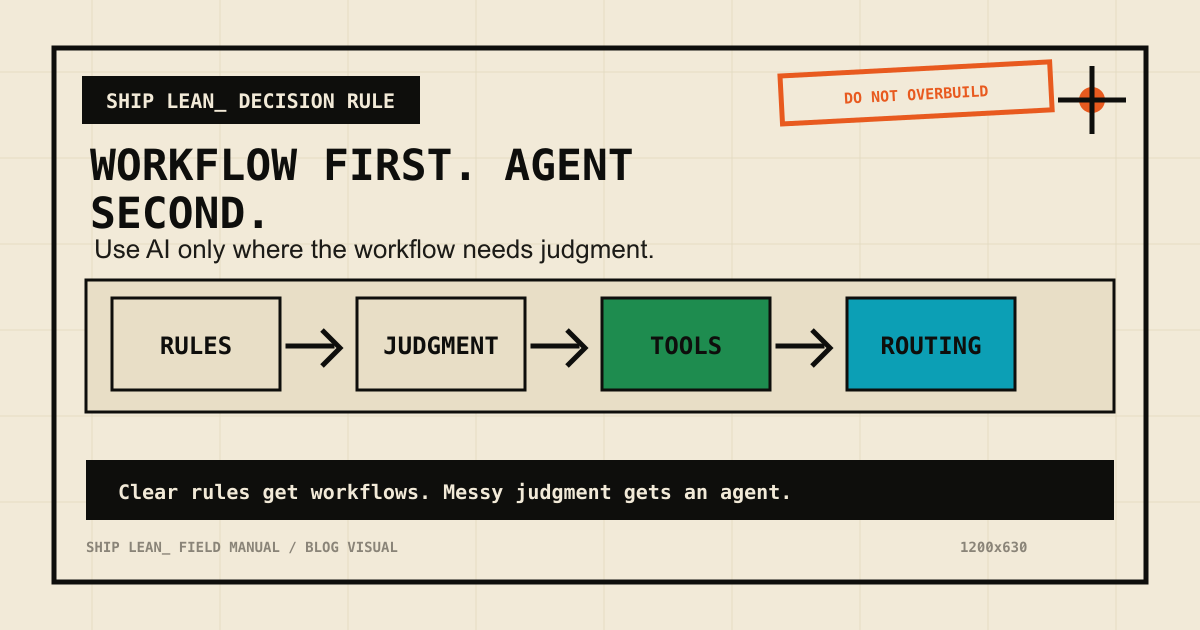
Use normal workflow automation when the rules are clear.
Use an n8n AI agent when one step needs judgment.
That is the whole decision.Situation
UseCopy data from form to CRM
Normal workflowSend Slack alert after status changes
Normal workflowClassify messy customer messages
AI agentScore Search Console queries for content ideas
AI agentDraft a newsletter from a build log
AI agent plus approvalPublish automatically to production
Probably notWorkflow automation is for known steps
Normal automation is best when you can describe the rule clearly:when this happens, do that
if status is approved, send email
every Monday, pull this report
when form submits, create taskYou do not need an AI agent for that.
Adding one usually makes the workflow slower, harder to debug, and more expensive.
AI agents are for fuzzy steps
Use an agent when the workflow needs to interpret something:Is this lead qualified?
Is this query worth a page?
Does this transcript contain a strong proof moment?
Is this support message urgent?
Should this draft be published, revised, or killed?That is not a simple if/then branch. That is judgment.
The clean hybrid pattern
The best setup is usually both:n8n triggers the workflow.
n8n gathers data.
The agent handles the fuzzy decision.
n8n routes the result.
A human approves high-risk output.That gives you automation without pretending the agent should own the whole process.
Use the Claude Code + n8n Workflow Planner to split the work before building. If you're choosing between a coding agent and a workflow runner, read AI coding agent vs workflow automation.
What solo builders should build first
Start with a workflow where bad output is annoying, not catastrophic.
Good:content idea scoring
transcript repurposing
newsletter draft creation
lead triage draft
workflow planningBad:customer refunds
publishing without review
deleting production data
sending sales emails with no approvalThe goal is not to make the agent powerful. The goal is to make it useful and bounded.
FAQ
What is the difference between an n8n AI agent and workflow automation?
Workflow automation follows known rules. An n8n AI agent handles the judgment step inside a workflow.
Should every n8n workflow use an AI agent?
No. Use normal automation when the steps are clear and rule-based. Add an agent only when the workflow needs reasoning.
An n8n AI agent is a workflow step that uses an LLM plus tools to make decisions inside an automation.
The short version:Part
Jobn8n
Trigger, gather data, route output, retry failuresAI agent
Read context, decide, draft, classify, score, or planTools
Let the agent check data or take actionHuman approval
Protect anything public, expensive, or brand-sensitiveThe mistake is thinking the AI Agent node is magic by itself. It is not.
The node becomes useful when it has a clear job, enough context, and access to the right tools.
The plain-English version
Think of n8n as the operations desk.
It knows when something happened. A form came in. A video published. A Search Console export landed. A Notion status changed.
The AI agent is the person at the desk who can read the packet and make a call.
Should this lead go to sales? Should this query become a tool page? Should this transcript become a newsletter? Is this task worth automating?
That decision is the agent's job.
The routing, logging, retries, and notifications are n8n's job.
What makes it agentic?
An agentic workflow has more than a prompt.
It has:a trigger
context
a decision
tools or actions
memory or history when needed
a clear output
an approval gate when consequences existWithout tools or actions, the agent is usually just an LLM response inside a workflow.
That can still be useful. But it is not the same as an agent that checks, decides, and routes.
A simple n8n AI agent workflow
Here is the pattern I would start with:n8n detects a new input.
n8n gathers the context.
The agent makes one specific decision.
n8n saves the decision.
A human approves if needed.
n8n routes the output.Use the n8n AI Agent Workflow Builder to map that before you build.
For the full Ship Lean path, use the n8n AI Agents hub. It connects this definition to the workflow pattern, builder tool, and Claude Code/n8n handoff.
Good first use cases
For solo builders, good use cases are boring:score Search Console queries
classify inbound leads
turn a build log into a newsletter draft
summarize support requests
route content ideas
check if a workflow is worth automatingBad first use case: "run my whole business."
Start with one judgment step.
n8n AI agent vs Claude Code
n8n AI agents are good inside recurring workflows.
Claude Code is better when the task needs repo context, file edits, code changes, or a real implementation pass.
Use both when the workflow needs a trigger and a code-aware operator:n8n detects and gathers
Claude Code edits or drafts
human approves
n8n routesRead the full decision rule in Claude Code vs n8n.
FAQ
What is an n8n AI agent?
An n8n AI agent is an automation step that uses an LLM plus tools to reason over context and take actions inside a workflow.
Is the n8n AI Agent node agentic by itself?
Not really. It becomes agentic when it can use tools, check context, make decisions, and route work instead of only generating text.
When should solo builders use an n8n AI agent?
Use it when one repeatable workflow needs judgment, classification, drafting, scoring, or routing.
Quick answer: An n8n AI agent is the AI Agent node plus tools (HTTP, database, code, APIs) that lets an LLM read context, call those tools, and pick the next step on its own. Without tools, it is just a chatbot in a workflow. The Ship Lean pattern: Claude/Codex builds, n8n runs, human approves.
If you're trying to figure out whether you even need an agent, start with what an n8n AI agent is and n8n AI agent vs workflow automation. Short version: agents are for judgment calls, not every automation.
If you want the whole path in one place, start with the n8n AI Agents hub. It links the definition, workflow pattern, builder tool, and Claude Code handoff.This tutorial answers the search cluster Google is already testing:Query
Direct answern8n ai agent
Use the AI Agent node only when the workflow needs judgment.n8n ai agent workflow
Trigger in n8n, let the model make one scoped decision, route the result, then approve risky output.n8n agentic workflow
The agentic part is tool use plus structured decisions, not just an LLM prompt.n8n ai agent node
The node is the reasoning step; n8n still owns triggers, credentials, routing, retries, and run history.what is n8n ai agent
It is an LLM-powered workflow step that can use tools and return a decision inside automation.I built my first "agent" in n8n and felt very smart for about ten minutes.
Then I realized I'd just made a fancy ChatGPT call. Input went in. Output came out. Nothing decided. Nothing checked. No tools.
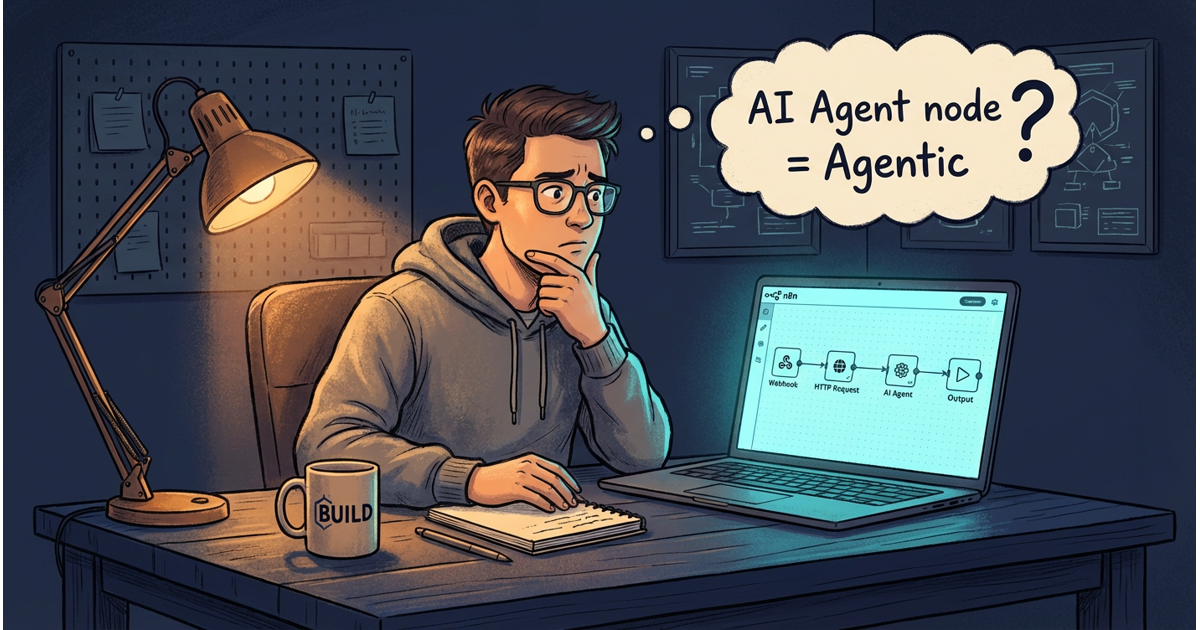
That's the gap nobody flags in the tutorials: dropping the AI Agent node into a workflow doesn't make it agentic. It makes it an LLM with a trigger.
This post is the version I wish I'd had when I started: what an n8n AI agent actually is, when to use one instead of a normal workflow, and the pattern I use now that keeps me out of multi-agent spaghetti.
What Changed in 2026
n8n is no longer just "Zapier, but flexible." It is moving toward a durable AI workflow layer: agent nodes, tools, memory, structured output, retries, credentials, and run history in one canvas.
That matters because the winning pattern is not "let the model do everything." The winning pattern is:Layer
Best owner
WhyPrompt, schema, tool design
Claude Code or Codex
Repo context, writing, code, and judgmentTrigger, credentials, retries
n8n
Durable workflow operationsFuzzy decision
AI Agent node
Reads context and chooses a tool or answerPublic/customer action
Human approval
Keeps trust where it belongsAs of this refresh, n8n's AI Agent node is a versioned node with current support for tools and output parsers. n8n's own Tools Agent docs describe the agent as the piece that can choose external tools and return a standard output format. That is the part solo builders should care about: not "AI magic," but repeatable decisions with visible runs.
Use current language when you build:AI Agent node for the reasoning step
Tools for API/database/app actions
Structured Output Parser when downstream nodes need clean fields
Memory only when the task needs prior conversation or prior user state
Retries and run history for boring reliabilityIf you only remember one thing, remember this: n8n is the runner, not the whole brain. The AI Agent node should own one fuzzy decision. Everything before and after that should be boring workflow automation.
What Is an n8n AI Agent?
An n8n AI agent is a workflow built around the AI Agent node with tools attached: usually HTTP Request, a database, Airtable, code, or other n8n nodes. That lets the LLM do three things in a loop:Read the input and current context
Decide whether to call a tool (and which one)
Use the tool's output to pick the next action or final answerThe "agentic" part is the loop. The model isn't just generating text. It's choosing actions based on what it finds.
Without tools, the AI Agent node is a fancy LLM call. With tools, it can look things up, write to a database, hit an API, and reason about the result before answering.
For AEO purposes, this is the clean definition:An n8n AI agent is a workflow where the AI Agent node can use tools, memory, and structured output to make a judgment step inside a larger automation.n8n AI Agent vs Regular Workflow Automation: When to Use Which
I default to plain workflow automation. Agents are the exception, not the rule.Situation
Use a regular workflow
Use an AI agentInputs are predictable (form fields, structured webhook)
✅Logic fits a clean if-then tree
✅You need messy text classified or summarized✅You need it to look something up before deciding✅Output has to be structured every time, no surprises
✅Edge cases keep slipping through your filters✅Cost per run matters and volume is high
✅Rule of thumb I use:If I can write the rules in 10 minutes, it's a workflow. If I'd need 50 if-statements and still miss cases, it's an agent.A workflow that classifies email tone with keyword matching will miss "I've been waiting three weeks and this is getting ridiculous." An agent reads it and routes it correctly. That's the kind of decision worth paying tokens for.
If the decision is "did the Stripe webhook fire? then send the receipt," don't put an LLM in the path.
For a deeper split, read n8n AI agent vs workflow automation. If the question is whether Codex, Claude Code, or n8n should own the work, use AI coding agent vs workflow automation.
The Ship Lean Agent Pattern
Here's the layout I use now. It's not clever. That's the point.1. n8n handles the trigger and routing.
Webhook, RSS, schedule, Airtable change: n8n is good at this. Don't make the LLM do it.
2. The LLM handles judgment.
This is the AI Agent node (or a Claude Code call via HTTP). It reads context, calls tools, returns a structured decision. One agent, one job.
3. Tools are scoped tight.
Read-only when possible. Pre-filtered queries, not "here's the whole database." Every tool is a surface area you have to trust.
4. A human approves anything that ships.
Sends an email to a customer, charges a card, posts to a public account, deploys code: that goes to a Slack/Telegram approval step before it executes. The agent drafts; you click yes.
5. Claude Code does the building, n8n does the running.
I draft prompts, tool definitions, and workflow logic in Claude Code or Codex. n8n runs the workflow on a schedule. GitHub holds the workflow JSON. Vercel hosts anything customer-facing. Each tool does what it's good at.
That's the whole stack. No swarm of sub-agents. No "AI orchestrator" picking other agents. One agent, scoped tools, human in the loop where it matters.
The 2026 Build Checklist
Before you touch the n8n canvas, write these five things down:Decision
Good answerAgent job
"Score this Search Console query as BUILD, REFRESH, or IGNORE."Input
Query, URL, impressions, clicks, position, current page summaryTools
Read page content, inspect sitemap, write row to task tableOutput
JSON with decision, reason, priority, next_actionApproval
Human approves new public pages and page refreshesIf you cannot fill in that table, the workflow is not ready. You do not have an agent problem yet. You have a scope problem.
What You Need Before BuildingAn n8n instance. I self-host on Hostinger so I'm not paying per execution.
An API key. I use Claude Sonnet for most agent work because the structured output behaves.
A clear, single decision you want automated
Airtable or a database if your agent needs memoryIf n8n is new to you, run through the n8n tutorial for beginners first.
Use a manual trigger while you're building. You'll run the thing 30+ times tweaking prompts, and you don't want an RSS feed or webhook firing each time.
Step 1: Pick One Decision
Every agent needs one job. Not three. One.
Bad: "Read my inbox, write replies, schedule meetings, and update the CRM."
Good: "For each new RSS post, decide if it's worth sharing with my list. Output SHARE or SKIP and a one-line reason."
The narrower the scope, the easier it is to prompt, test, and trust. If you can't describe the agent's job in one sentence, the agent isn't ready to be built.
Step 2: Trigger and Input
For the example, we'll keep using the content filter: an RSS feed pulls new posts, each post becomes input.
The trigger's job is to give the agent enough context to make the call: title, link, full text, source. If your input is thin, the agent's decisions will be thin too.
Step 3: Add the AI Agent Node
Drop in the AI Agent node. Connect the trigger.
Configure:Provider/model: Claude Sonnet is my default for judgment work
System prompt: define the job, the criteria, and the output format
Output parser: use structured output when another node needs reliable fields
Memory: add it only if the workflow needs prior conversation or prior user stateExample system prompt:
You are a content relevance filter for a newsletter aimed at solo AI builders
who use Claude Code, n8n, and ship products on the side.For each post, decide:
- Relevance: High / Medium / Low (does it help this audience build or ship?)
- Quality: High / Medium / Low (is it specific and actionable, or generic?)
- Decision: SHARE or SKIP
- Reason: one line, plain languageDefault to SKIP when uncertain. We'd rather miss a marginal post than share a weak one.This alone is not an agent yet. It's an LLM with a prompt. It reads, it answers, that's it.
The next step is what changes that.
Step 4: Attach Tools and Structured Output
Tools are how the agent does things instead of just saying things.
In n8n, common tool options:HTTP Request: call any API
Database / Airtable / Postgres: look up or write history
Code: custom logic when needed
Other n8n nodes: wrapped as toolsFor the content filter, attach an Airtable tool pointing at a "Shared Posts" table. Update the prompt:
Before deciding, use the Airtable tool to check the "Shared Posts" table for
posts shared in the last 30 days. If a similar topic was already covered,
lean toward SKIP unless this post is meaningfully better or newer.Now the agent isn't analyzing a post in a vacuum. It's checking history, comparing, and using that to decide. That's the loop.
You don't need n8n's sub-agent feature for this. I almost never reach for it. One agent + a few tools handles most things I've thrown at it.
When the next node expects clean data, do not make it parse paragraphs. Require structured output:
{
"decision": "SHARE",
"reason": "Specific walkthrough for solo AI builders.",
"confidence": 0.82,
"approval_required": true
}This is the difference between a demo and a workflow you can run every week.
Step 5: Wire the Decision to Action
The agent returns something like:
Decision: SHARE
Reason: Concrete walkthrough of building a Claude Code subagent. Fits the audience.Downstream, you don't need a 12-branch if-then. You need one router checking Decision === "SHARE". The complexity lives in the agent's reasoning, not in the canvas.
For anything that goes out the door, like a tweet, an email, or a published post, route it to a human approval step. A Slack message with Approve/Reject buttons works fine. The agent drafts. You ship.
If you are building this for Ship Lean-style traffic work, the approval step matters even more. New pages, refreshed titles, comparison claims, and public recommendations should not publish automatically. The workflow should prepare the draft and evidence. A human should approve the point of view.
Step 6: Test on Real Data, Not Your Imagination
Your first version will be wrong. That's fine. Plan for it.
What I run into most:Vague prompts: agent makes inconsistent calls because the criteria are fuzzy
Tool not actually wired: agent "tries" the tool but the connection is broken
Output drifts: sometimes structured, sometimes prose
Real inputs are messier than your test inputsFix loop is always: tighten the prompt, add an example or two of correct output, narrow the tool's scope.
Step 7: Add the Boring Reliability
This is where n8n earns its keep.
For any workflow you plan to keep:Log every run somewhere boring: a Sheet, Airtable table, Postgres row, or Notion database.
Save the input, decision, model, cost estimate, and approval result.
Add retries where the failure is likely temporary.
Alert yourself when the workflow fails or the output parser breaks.
Keep credentials in n8n, not pasted into prompts.AI builders love the agent part. Operators love the run history. Organic traffic comes from writing about the version that actually survives contact with real inputs.
What My Real n8n Workspace Shows
When I checked my own n8n workspace, the pattern was obvious: lots of experiments, one production workflow doing a clear job.
The active workflow is not a mystical multi-agent swarm. It is a content scheduling runner:A Notion trigger starts the run.
n8n grabs the page, length, and assets.
A filter, code step, and switch route the item.
Blotato nodes send the asset to YouTube, Instagram, X, TikTok, and LinkedIn.
n8n updates the status back in Notion.That is the lesson. The workflows that survive are not always the flashiest ones. They are the ones with a narrow trigger, clear routing, visible status, and boring handoffs.
Most of the other workflows in my account are paused experiments: idea engines, social research, lead routing, newsletter systems, job prep, payment reminders, and old tests. That is normal. n8n becomes more valuable when you label the experiments, retire the stale ones, and keep production workflows boring enough to trust.
The best public example from that inventory is not the active content scheduler. It is the lead qualification pattern.
The private workflow has the shape that actually teaches the idea:A webhook receives a lead.
n8n enriches the lead data.
An AI step qualifies the lead.
A structured parser turns the model response into fields.
n8n routes the result into hot lead, nurture, Slack, and email paths.That is the useful proof: the model makes one judgment call, then n8n routes the outcome. For a public template, I would not publish the private workflow raw. I would publish the cleaned pattern instead, with fake sample data and no credentials.
You can download that starter pattern here: n8n human approval workflow JSON. I also published the proof asset on GitHub: n8n AI lead qualification workflow with human approval.
What I Got Wrong Early
My first n8n agent system was a faceless YouTube pipeline: Reddit scrape to script to 11Labs voiceover to Creatomate render. Took me a couple weeks. Had four agents where one would've done.
It worked. The output wasn't great, but it ran. The lesson wasn't "agents are powerful." It was: I built before I validated, and I overcomplicated every step.
The rewrite was always the same: collapse to one agent, scope its tools, put a human at the publish step.
That's the version I'd build today, and it's the version above.
Common Mistakes That Keep Your Agent Dumb
1. Using the AI Agent node with no tools.
You built a chatbot. Tools = autonomy. No tools = no decisions worth calling agentic.
2. Multi-agent setups before you need them.
Sub-agents and agent loops exist. Skip them until a single agent has clearly hit its ceiling. It usually hasn't.
3. Vague system prompts.
"Make good decisions" isn't a prompt. Spell out criteria, output format, and what to do when uncertain.
4. No human approval on outbound actions.
The first time an agent emails a customer something weird, you'll wish you had this. Add it before you need it.
5. Testing only on data you wrote.
Real inputs break things synthetic ones don't. Test on actual feeds, actual emails, actual rows.
6. Adding memory because it sounds advanced.
Memory is useful for ongoing conversations. It is usually unnecessary for one-shot scoring, routing, enrichment, and drafting workflows. Start stateless, then add memory only when the missing context is actually hurting results.
7. Treating structured output as optional.
If n8n needs to route the result, make the agent return fields. Prose is for humans. JSON is for the next node.
Where to Go From Here
Pick one decision you make repeatedly that's annoying because it requires reading something: inbox triage, lead scoring, content filtering, support routing.
Build that. One agent, one tool, one decision. Run it manually for a week. Watch where it gets confused. Tighten the prompt.
Once that's working, the second one takes half the time. The third feels normal.
For more patterns, see 7 n8n workflow examples, what an n8n AI agent is, n8n AI agent vs workflow automation, n8n vs Make for AI agent workflows, and Codex vs n8n if you're still deciding which side of the line your use case sits on.
The AI Agent node is a building block, not the whole building. Tools are what turn it into something that decides. Keep the rest of the stack boring: n8n for plumbing, Claude Code for judgment, GitHub and Vercel for everything that ships. Then you can spend your time on the decisions, not the wiring.
My first n8n workflow was clunky, overcomplicated, and had four agents where one would have done.
But it worked.
That ugly pipeline scraped Reddit, wrote scripts, generated voiceovers, and stitched everything together with Creatomate. A faceless YouTube setup, built by someone who'd never touched n8n before. I never published from it - the real value was learning the tool.
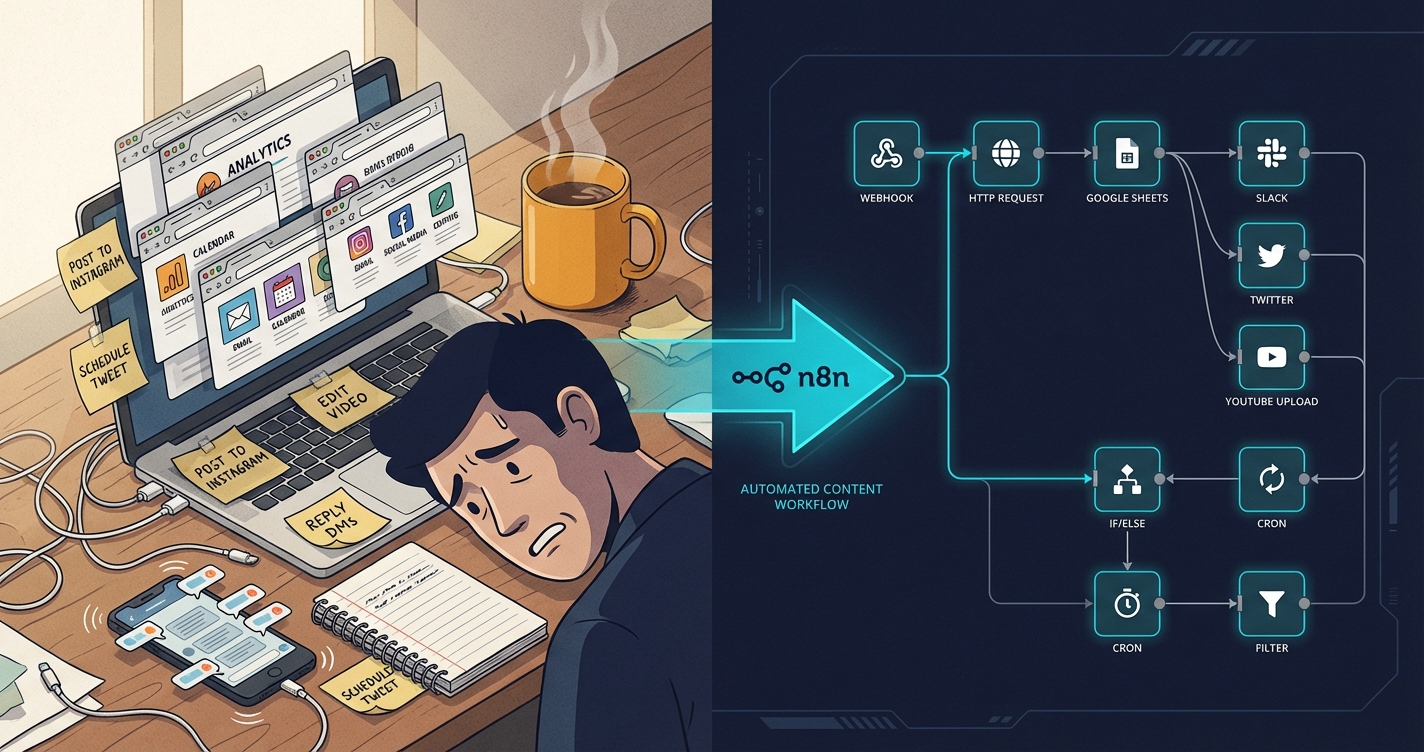
Here's the thing about content work: the actual creative part is maybe 20% of the time. The other 80% is formatting, scheduling, cross-posting, research. The repetitive tasks that pile up before you even start writing.
n8n is the layer I keep coming back to for that 80%. Self-hosted, unlimited workflows, no per-task fees.
Quick caveat before the list: building the right automation matters more than building one well. I've burned plenty of weekends on systems I never used. Here's the framework I use now to decide what's worth automating - run any workflow on this list through it before you commit.
What follows are seven workflows I either run or have built. Treat the time and engagement notes as my own ballparks, not promises - your numbers depend on your volume and audience.
If you're deciding where n8n should sit next to a coding agent, read my Claude Code vs n8n decision rule first. n8n is best as the reliable trigger/routing layer, not the whole brain.Why n8n Over Other Automation Tools?
Before diving into the workflows, let me address the obvious question: why n8n?
I've tried them all. Zapier's pricing made me do math every time I wanted to automate something. Make (formerly Integromat) is solid, but the visual interface gave me headaches.
n8n hits different:Self-hosted option: Run it on a small VPS and skip per-workflow fees
Unlimited executions: No task counters
Visual workflow builder: See exactly what's happening at each step
Big integration library: Connect to most of the tools you already use
Open source: Community nodes cover the edge casesThe learning curve is real - plan on a weekend to get comfortable. But once it clicks, the per-workflow cost goes near zero. (New to n8n? Start with my beginner's tutorial that walks through the interface and your first workflow.)
Workflow 1: Content Repurposing Engine
What it's for: Stop manually rewriting the same idea into five formats.
This is the workflow that started it all. I write one blog post, and n8n transforms it into:3 LinkedIn posts (hook, insight, story format)
5 Twitter/X threads
1 YouTube script outline
1 newsletter sectionHow it works:Webhook triggers when I publish a new post
Claude API extracts key insights and quotable moments
Separate branches format content for each platform
Everything lands in my Notion content calendarWant more powerful AI integration? If you want to make Claude truly autonomous - not just generating content, but making decisions and using tools - check out my guide to building agentic workflows with n8n's AI Agent node.
The work is in the prompts. Generic "summarize this" prompts produce garbage. I keep iterating on prompts that match my voice and each platform's shape - it's never one-and-done. (Want to see the exact prompts I use? They're in my social media automation tutorial.)
Setup time: About 2 hours for the full pipeline
Key nodes: Webhook Trigger → Claude AI → Multiple branches → Notion API
Workflow 2: Social Media Scheduler with Engagement-Aware Timing
What it's for: Stop manually scheduling every post and stop posting at the same fixed time regardless of what's working.
I used to manually schedule every post. Now I batch-write and n8n handles the rest.
The twist: it doesn't just schedule - it nudges posting time based on past engagement.
How it works:Cron trigger runs daily
Pulls upcoming posts from my content queue
Checks past engagement data from my spreadsheet
Adjusts posting times to land closer to when my audience is actually around
Schedules via Buffer APIThe data-driven scheduling matters less than people think. The bigger win is just being consistent.
Setup time: 90 minutes for a basic version. Add the engagement layer once you have a few weeks of data.
Pro tip: Start simple. Get the basic scheduling working before adding the AI optimization layer. If you want the step-by-step build, see how to automate social media posts with AI.
Workflow 3: Trending Topics Monitor
What it's for: Stop endlessly scrolling for what's blowing up. Let the workflow shortlist it.
How it works:Scheduled trigger every few hours
Pulls from a few sources: subreddits I care about, X/Twitter trends, Google Trends
Claude scores each item for relevance to my audience
Filters by quality
Sends a Slack message with the top few opportunitiesThe real value isn't time saved - it's catching topics while they're still warm. Most won't be worth covering. The point is to surface the few that are.
Setup time: A couple of hours
Note: Reddit API requires developer access. The X API got expensive. Perplexity, news APIs, or RSS-based sources are reasonable alternatives.
Want a content flywheel built around your videos? If you'd rather skip the wiring entirely - workflow, voice prompts, approval queue - take a look at Content Flywheel DFY.Workflow 4: Email Newsletter Automation
What it's for: Cut the "blank-page Thursday" panic before sending a weekly newsletter.
My newsletter workflow is embarrassingly simple, but it removed the biggest weekly headache.
How it works:Every Thursday at 9 AM, workflow triggers
Pulls my top-performing content from the week (based on analytics)
Grabs any bookmarked links from my research
Claude drafts the newsletter with my structure
Sends draft to my email for reviewI still edit and personalize. But the 80% that's just assembly? Automated.
Setup time: 1 hour
Key insight: Don't try to fully automate newsletters. The personal touch matters. Automate the structure, not the soul.
Workflow 5: Research and Clipping Pipeline
What it's for: Stop losing the ideas that pop up at random times.
Every content creator has the same problem: ideas pop up at the wrong moment and disappear before you can use them.
This workflow captures everything.
How it works:Multiple entry points: email forwarding, Slack command, browser extension webhook
Everything funnels into a central processor
Claude categorizes, tags, and summarizes
Stores in Notion with full metadata
Weekly digest of unused clipsMy "content ideas" folder used to be a graveyard. With this in place, it's at least searchable and tagged - which is the difference between an idea I can find later and one I lose.
Setup time: 2 hours
The thing that actually matters: The categorization step. Without it, you just create a different kind of mess.
Workflow 6: YouTube Thumbnail and Title Testing
What it's for: Stop guessing at titles and thumbnails for every upload.
How it works:When I upload a video, the workflow triggers
Generates several title variations using Claude
Creates thumbnail text variations
Runs YouTube's built-in title test
Logs results to a spreadsheet for pattern analysisOver time, you build a small dataset of what actually works for your audience instead of generic "best practices" from a thumbnail course.
Setup time: A couple of hours
Requires: YouTube API access and some patience for data collection
Workflow 7: Content Performance Dashboard
What it's for: Stop opening five analytics tabs to figure out what's working.
This workflow doesn't create content. It tells me what's working.
How it works:Daily trigger at midnight
Pulls analytics from: Google Analytics, YouTube, Twitter, LinkedIn
Normalizes data and calculates week-over-week trends
Generates a Slack report with insights
Flags posts that need updating or promotionThe strategic value is hard to quantify. But having a single daily report instead of five tabs makes it more likely I'll actually look at the numbers.
Setup time: 3 hours (most complex workflow on this list)
Note: Analytics APIs can be finicky. Expect some debugging.
Getting Started: The Practical Path
Don't try to build all seven workflows this weekend. That's a recipe for burnout.
Here's what I'd recommend:
Week 1: Pick ONE workflow that addresses your biggest pain point. Build the simplest version that works.
Week 2: Refine that workflow. Add error handling. Test edge cases. Make it bulletproof.
Week 3: Add a second workflow. Build on what you learned.
Each workflow you finish makes the next one easier - you reuse credentials, prompt patterns, and debugging instincts. That's the real compounding, not a tidy hours-saved number.
The Honest ROI Picture
Let me be straight about what to expect:
Upfront investment:n8n learning curve: a weekend, give or take
Each workflow: a few hours to build, more to make reliable
Refinement: ongoingReturns:Less time on the boring 80% (formatting, scheduling, cross-posting)
Faster turnaround on ideas
Less burnout
A system you can keep editing instead of rebuilding from scratchWhat you don't get: a magic ratio. Time savings depend on what you're already doing manually. The compound effect shows up after a few months of running and tweaking, not week one.
Common Mistakes to Avoid
The repeating mistakes I see (and have made):Over-engineering from day one. Start simple. Add complexity later.No error handling. Workflows break. Build in notifications so you know when they fail.Generic AI prompts. The quality of your AI-powered workflows depends entirely on your prompts. Invest time here.Forgetting the human element. Some things shouldn't be automated. Editorial judgment, relationship building, creative direction - keep those human.Not documenting. Future you will thank present you for leaving notes about what each workflow does and why.What's Next
These seven workflows are the foundation I keep coming back to. They handle the boring parts so I can spend time on the parts that actually need a human.
Automation isn't about being lazy. It's about being strategic with the time you actually have.
Pick one workflow. The one that'll remove the chore you hate most. Build that this week.
Then come back and grab the next one.
More n8n Tutorials
Step-by-step guides with screenshots, prompts, and the patterns I use:Social Media Automation: How to automate social media posts with AI
Agentic workflows: n8n AI Agent tutorial
Stack split: Claude Code vs n8nGet the free prompt pack →
 Chris Alarcon